
Understanding Quality Assurance in Pharma and Biopharma: The Architects of Process Excellence
What is Quality Assurance in Pharma and Biopharma?
Quality Assurance (QA) in the pharmaceutical and biopharmaceutical industries is a proactive, systematic framework aimed at preventing quality issues by establishing, implementing, and maintaining robust processes, standards, and controls throughout the product lifecycle. Unlike Quality Control (QC), which verifies products through testing, QA focuses on the “how” of manufacturing—designing, documenting, and auditing systems to ensure consistent compliance with regulatory requirements like those from the FDA, EMA, and ICH guidelines. It encompasses policies, procedures, and cultural elements that embed quality into every stage, from R&D to distribution, fostering a state of control that minimizes deviations and maximizes reliability.
In biopharma, where variability in biological materials like cell lines or recombinant proteins is inherent, QA is particularly crucial for risk-based approaches that anticipate challenges like process drift or supply chain disruptions. At its core, QA builds confidence that products will meet specifications without exhaustive end-product checks, promoting efficiency and innovation while upholding GMP (Good Manufacturing Practices) and patient-centric principles.

The Role of QA in the Pharma and Biopharma Industries
In the pharmaceutical sector, QA streamlines production of small-molecule drugs by standardizing workflows for high-throughput operations, reducing errors in batch records or equipment calibration. For biopharma, it safeguards complex processes like upstream cell culture or downstream chromatography, where a single procedural lapse could invalidate an entire campaign. QA’s preventive ethos shifts the industry from reactive fixes to predictive excellence, enabling faster approvals and scalable operations.
Key contributions include:
- Risk Mitigation: Employing tools like Failure Mode and Effects Analysis (FMEA) to foresee and avert issues, as demonstrated in preventing contamination events that plagued early biologics production.
- Regulatory Alignment: Developing SOPs (Standard Operating Procedures) and change controls that satisfy cGMP audits, streamlining inspections and global harmonization via pharmacopeias (USP, EP).
- Efficiency Gains: Through process optimization and CAPA (Corrective and Preventive Actions), QA cuts downtime and costs—vital in biopharma where development timelines can span years.
- Cultural Integration: Promoting a “quality mindset” via training, ensuring cross-functional teams from R&D to manufacturing prioritize compliance.
As the industry embraces digital twins and continuous verification, QA evolves to incorporate data integrity and AI oversight, reinforcing its role as the strategic enabler of safe, effective therapies.

Sub-Departments in QA: Specialized Stewards of Process Integrity
QA is structured into functional sub-departments that oversee different facets of quality management, collaborating seamlessly to create a unified quality ecosystem. These units emphasize documentation, validation, and continuous improvement, with activities often spanning the facility. Below, we elaborate on key sub-departments, their responsibilities, and core functions.
QMS (Quality Management System): The Central Hub of Oversight
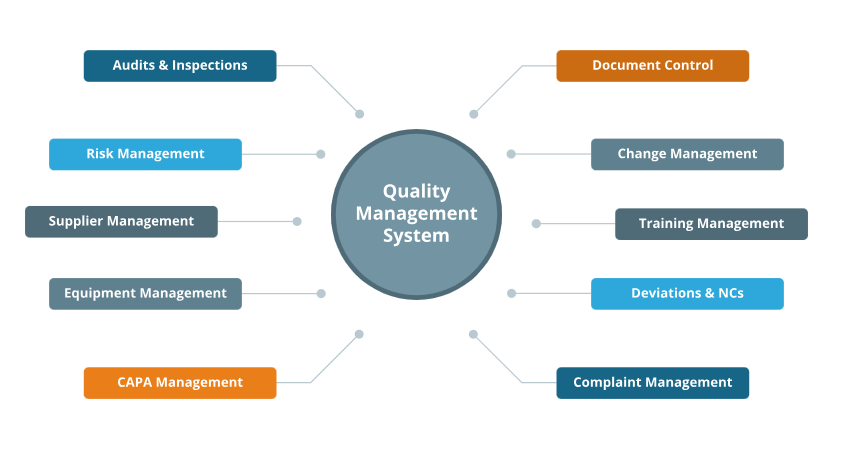
The QMS sub-department designs, deploys, and maintains an integrated Quality Management System to orchestrate all QA activities, providing a holistic framework for planning, control, and improvement. In pharma, it standardizes batch production; in biopharma, it manages risk across multi-stage processes, aligning with ICH Q10 for a pharmaceutical quality system.
Core functions and elaborations:
- System Design and Implementation: Establishing policies, objectives, and metrics (e.g., KPIs like deviation rates) to embed PDCA (Plan-Do-Check-Act) cycles.
- Performance Monitoring: Using dashboards for real-time tracking of quality indicators, enabling proactive adjustments in dynamic biopharma environments.
- Integration with Other Systems: Linking QMS to ERP or LIMS for seamless data flow, ensuring traceability from supplier to patient.
- Continuous Improvement Initiatives: Leading Kaizen events or Six Sigma projects to refine processes based on trend analysis.
This department ensures QMS acts as the organization’s quality compass, driving sustained excellence.
Regulatory Affairs: Navigating Compliance and Submissions
Regulatory Affairs (RA) manages interactions with agencies, preparing and submitting dossiers while interpreting evolving regulations to keep operations compliant. It’s pivotal in pharma for generic approvals and in biopharma for biologics licensing, handling complexities like biosimilar pathways.
Core functions and elaborations:
- Dossier Preparation and Submission: Compiling CTD (Common Technical Document) modules for IND/NDA/BLA filings, including stability data and risk assessments.
- Regulatory Intelligence and Gap Analysis: Scanning updates (e.g., EMA reflections) to assess impact and recommend adaptations, such as post-Brexit alignments.
- Agency Liaison and Inspections: Coordinating responses to queries or PAI (Pre-Approval Inspections), preparing teams with mock drills.
- Global Harmonization: Aligning strategies for multi-regional approvals, navigating variances like FDA vs. PMDA requirements.
RA’s expertise accelerates market access while mitigating approval delays.
Archives: Safeguarding Historical Records
The Archives sub-department securely stores, retrieves, and disposes of quality records, ensuring long-term integrity and accessibility for audits or legal needs. In regulated environments, it preserves everything from batch records to validation reports, compliant with 21 CFR Part 11 for electronic records.
Core functions and elaborations:
- Record Retention and Storage: Classifying documents by lifecycle (e.g., 10+ years for pharma stability data) in climate-controlled or digital vaults.
- Retrieval and Archival Systems: Implementing barcode or AI-search tools for efficient access, with audit trails to prevent tampering.
- Disposition Protocols: Scheduled destruction of expired records per retention schedules, ensuring data privacy under GDPR.
- Disaster Recovery Planning: Backups and redundancy to protect against loss, critical for biopharma’s voluminous trial data.
This unit upholds the “right to know” while minimizing storage burdens.
Documentation and Training: Building Knowledge and Procedures
Documentation and Training develops, controls, and disseminates procedures while equipping personnel with skills to execute them flawlessly. It bridges policy to practice, essential for GMP adherence in pharma scaling or biopharma tech transfers.
Core functions and elaborations:
- SOP Authoring and Control: Creating user-friendly procedures with flowcharts, revised via change control to reflect best practices.
- Training Curriculum Design: Tailored programs (e.g., e-modules on aseptic gowning) with assessments, tracked for recency and competency.
- Knowledge Management: Curating libraries or wikis for quick reference, incorporating CAPA lessons to prevent recurrence.
- Multilingual and Cross-Functional Delivery: Adapting content for global teams, using VR simulations for high-risk training.
By empowering people, this department reduces human-error deviations.
Validation and Calibration: Verifying Reliability and Precision
Validation and Calibration ensures equipment, utilities, and processes are qualified and maintained to deliver consistent results, following a lifecycle approach. In pharma, it validates tablet presses; in biopharma, it qualifies fermenters for reproducibility.
Core functions and elaborations:
- Calibration Programs: Scheduled metrology checks (e.g., pipette accuracy to ISO 17025) with traceability to NIST standards.
- Validation Protocols (IQ/OQ/PQ): Executing risk-based plans for new installations, using DOE (Design of Experiments) for process bracketing.
- Requalification and Change Impact: Triggered reviews post-maintenance, assessing effects on validated states.
- Analytical Instrument Qualification: ANSI/ISA protocols for tools like balances, ensuring data integrity in QC handoffs.
This department’s rigor prevents variability that could compromise product quality.
Integrated Key Functions and Future Outlook
Spanning these sub-departments, overarching functions like deviation management and annual product reviews (APRs) synthesize data for continual enhancement. Digital tools like blockchain for traceability amplify QA’s reach.
As pharma/biopharma advances with real-world evidence and adaptive manufacturing, QA will pioneer predictive analytics and ethical AI governance. This forward-thinking stance cements QA’s legacy: not just assuring quality, but architecting it for a healthier tomorrow.